
CVD Diamond: The Complete Guide to Chemical Vapor Deposition Diamonds
What Is a CVD Diamond?
If someone told you a real diamond could grow inside a machine – no mining, no explosives, no damage to the Earth – you’d probably think that sounds like science fiction. But it’s not. It’s called a CVD diamond – the Purest Form of Diamond, and it’s one of the most exciting developments in the world of gemstones today.
CVD stands for Chemical Vapor Deposition. It’s the method used to grow a chemical vapor deposition diamond in a controlled lab environment. The result? A diamond that is physically, chemically, and optically identical to the one pulled from deep underground. Yes, identical. Even trained gemologists need special equipment to tell them apart.
How Is a Chemical Vapor Deposition Diamond Made?
Here’s where things get genuinely fascinating – and surprisingly simple to understand.
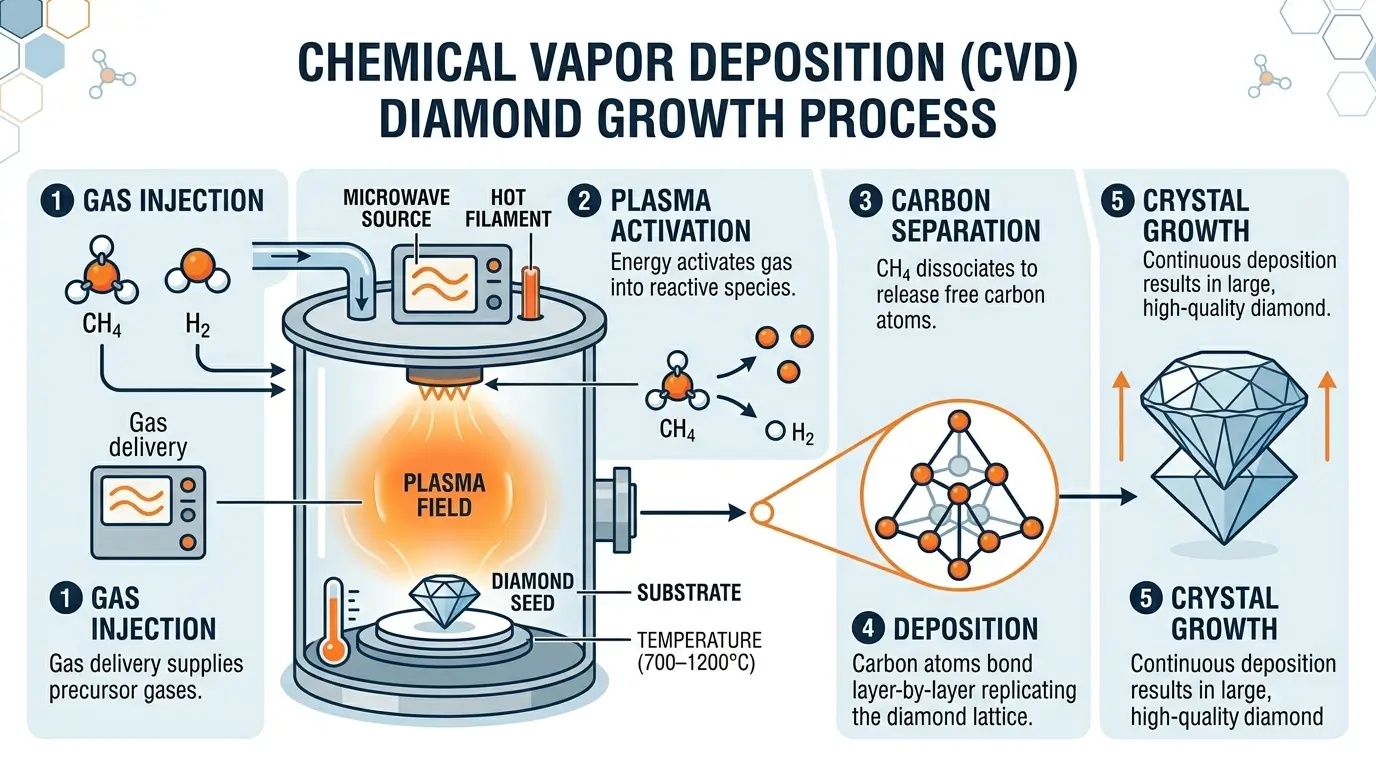
Imagine a sealed chamber, almost like a microwave oven, but much more powerful. Scientists place a tiny slice of diamond inside – called a diamond seed. Then, they fill the chamber with carbon-rich gases, usually methane and hydrogen. When the machine heats those gases to extreme temperatures (around 700–1,200°C), something remarkable happens. The carbon atoms break away from the gas and slowly attach themselves to the diamond seed, layer by layer, like building a wall one brick at a time.
Over the course of a few weeks, a full CVD diamond crystal grows from that tiny seed. The process is precise, repeatable, and produces stones of remarkable quality. This is the essence of chemical vapor deposition diamond technology – growing diamonds the way nature does, just faster and without digging into the earth.
Are CVD Diamonds Real Diamonds?
This is the most common question people ask – and the answer is a firm yes.
A chemical vapor deposition diamond has the exact same carbon atom structure as a mined diamond. Both are made of pure carbon arranged in a cubic crystal lattice. Both score 10 on the Mohs hardness scale – the hardest naturally occurring substance known to science.
The Gemological Institute of America (GIA), the world’s most respected gem lab, grades and certifies CVD lab grown diamonds just like mined stones. You’ll find reports listing cut, color, clarity, and carat – the same 4Cs.
The only real difference is origin. One formed over billions of years underground. The other grew in a laboratory over a few weeks. The atoms don’t know the difference.
Why Are CVD Diamonds Becoming So Popular?
The growth of the CVD diamond market isn’t just about price (though that matters). There are several reasons buyers – especially younger generations are choosing lab grown CVD diamonds:
- Ethical Sourcing – Traditional diamond mining has been linked to environmental destruction, labor exploitation, and in some regions, conflict financing. A chemical vapor deposition diamond has none of that history. You know exactly where it came from and how it was made.
- Environmental Impact – Mining one carat of diamond disturbs roughly 100 square feet of earth and produces nearly 6,000 pounds of mineral waste, according to industry estimates. Growing a CVD diamond requires electricity and gases – a significantly smaller environmental footprint, especially when powered by renewable energy.
- Price – A lab grown CVD diamond typically costs 50–70% less than a comparable mined diamond. That means you can buy a larger, higher-quality stone for the same budget. A 2-carat CVD diamond ring at the price of a 1-carat mined ring? That’s a real trade-off worth considering.
- Quality Consistency – Because the growth environment of a CVD lab grown diamond is precisely controlled, manufacturers can produce stones with consistently high clarity and color. In the natural diamond world, finding a D-color, VVS1 clarity stone is rare and expensive. In CVD production, it’s increasingly achievable.
How to Identify a CVD Diamond
Here’s something interesting: you cannot identify a CVD diamond with the naked eye. Even professional jewelers need specialized equipment like – IndiRAM Diamond Detection System and Portable Raman Spectrometer.
Some detection methods include:
- Photoluminescence spectroscopy – detects specific light emissions unique to CVD growth patterns
- UV fluorescence – CVD diamonds often show a distinctive orange or weak blue fluorescence
- DiamondView imaging – a tool used by GIA that maps growth patterns in the crystal structure
Reputable sellers will always provide a grading certificate from GIA, IGI, or another recognized lab. This certificate will explicitly state whether the diamond is a lab grown CVD diamond or HPHT. Always ask for it.
CVD Diamond Quality: What to Look For
When buying a chemical vapor deposition diamond, use the same 4C framework you would for any diamond:
Cut – The most important factor. A well-cut CVD diamond will sparkle brilliantly regardless of color or clarity. Look for Excellent or Very Good cut grades.
Color – CVD diamonds are commonly produced in the D – H color range (colorless to near-colorless). Avoid anything below if you want a white-looking stone in white gold or platinum.
Clarity – One of CVD’s biggest advantages. VS1 and VVS2 are common. SI1 can still be eye-clean. Avoid anything below SI2 unless you’ve seen the stone.
Carat – Because CVD lab grown diamonds cost significantly less per carat, you have real flexibility here. Don’t default to the smallest stone your budget allows.
The CVD diamond industry is growing at a rapid pace. According to market reports, the lab grown diamond market is projected to reach over $20 billion by 2030. Advances in reactor technology are making production faster and cheaper every year.
Beyond jewelry, chemical vapor deposition diamond technology is used in industrial applications – cutting tools, semiconductors, optical windows for lasers, and even medical devices. Diamonds grown through CVD are some of the hardest, most thermally conductive materials available.
As the technology matures, the quality gap between CVD and mined diamonds continues to close – while the price gap remains firmly in favor of the CVD lab grown diamond.
A CVD diamond is not a compromise. It’s not a lesser version of the real thing. It is the real thing – grown differently, priced fairly, and available without the ethical complications of traditional mining.
Whether you call it a chemical vapor deposition diamond, a lab grown CVD diamond, or simply a lab diamond, what you’re getting is a stone of genuine beauty, certified quality, and clear provenance.
The question isn’t whether CVD diamonds are worth buying. The question is whether you still have a reason not to.